The First Job Got Harder. Here's What the Data Says to Do.
New Census data on graduates after ChatGPT, and how to get ahead of it.

The First Real Data Is In
For three years, the conversation about AI and entry-level jobs has run on guesses, headlines, and anecdotes from friends who applied to two hundred roles. In September 2026, researchers at the U.S. Census Bureau published something different: hard numbers from real employment and earnings records, following bachelor's graduates from 2016 through 2024, about 29% of all bachelor's degrees awarded in the country over that stretch (Orr, Tucker and Warren, 2026, p. 3).
They sorted every major by how much of the work its graduates typically do can be performed by AI tools, then compared students who graduated before ChatGPT arrived in November 2022 with those who graduated after. If you are studying computer science, information systems, or a related field, the results are worth reading closely. If you are studying almost anything else, they are worth reading too, because they show exactly where the pressure is landing and how graduates are working through it.
What the Researchers Found
The impact is concentrated, not universal. The biggest changes landed on the most AI-exposed tenth of majors, which is mostly computer science, information systems, computer engineering, and other degrees closely tied to software development (p. 4). Most majors saw small changes either way. Nursing, criminal justice, and several health and social science fields actually saw initial employment rise (p. 35, Figure 10).
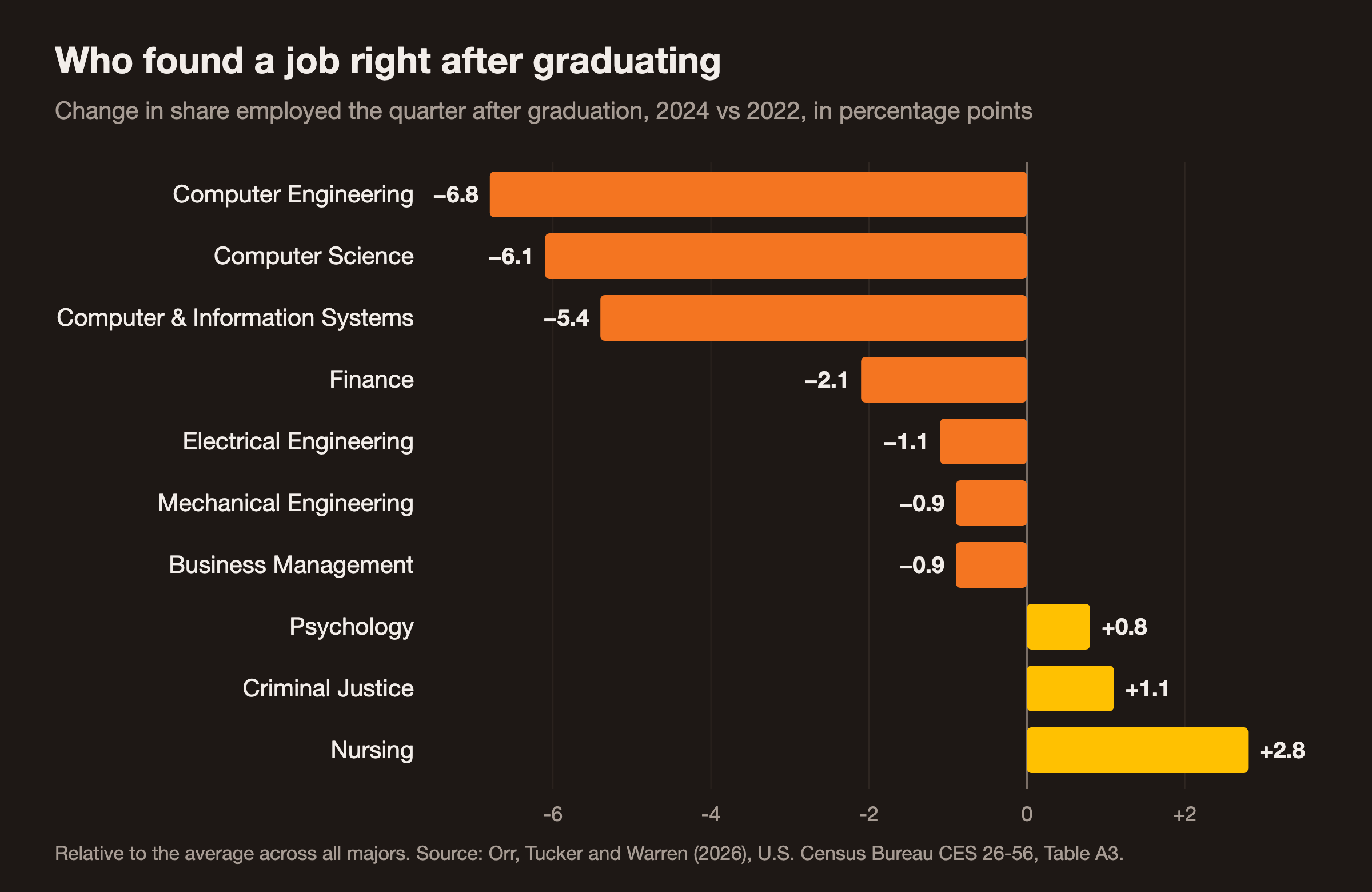
Fewer graduates in the most exposed majors landed a job right away. Their likelihood of being employed in the quarter after graduation fell by about five percentage points compared with graduates in the least exposed majors (p. 1).
The first paycheck got smaller. Early quarterly earnings for these graduates fell by about thirteen percent. The authors note that is comparable to the earnings hit of graduating into a large recession (pp. 1, 45).
Graduates took a detour. About half of that earnings drop came from where graduates ended up working. Fewer started in higher-paying sectors like information and professional services, and more started in retail, restaurants, and hospitality (p. 4). In other words, many took a first job below the level they trained for.
The gap shrinks over time. The earnings gap falls to roughly seven percent after one year and about five percent after two (pp. 3, 45). Graduates in exposed fields also became more likely to switch employers in their first two years, a sign that many took a weaker first job and then moved toward a better one (p. 44).
Why It Is Happening
The study does not pin the change on a single cause, but the authors lay out three likely explanations (pp. 46–47).
- AI is doing the tasks that used to belong to new hires. Routine coding, drafting, summarizing, and data cleanup were the traditional work of a first-year analyst or developer.
- Those tasks were also how people learned. Entry-level work has always been part production, part training. If AI absorbs that work, employers may hire fewer juniors and invest less in developing them.
- Your grades may be saying less than they used to. When AI can help produce polished assignments and work samples, employers have a harder time telling real skill from AI-assisted output. The authors cite research finding that AI availability has pushed grades up, especially in courses weighted toward homework, which makes those grades a weaker signal to employers.
Read those three together and a clear picture forms. The problem is not that employers have stopped needing capable people. It is that the old ways of proving you are capable, and of building capability on the job, are being disrupted at the same moment.
One more detail matters. The researchers ranked majors by what AI can do in the jobs their graduates typically take, not by how far companies have actually put it to work. And the authors point out that these effects showed up before most companies had widely adopted AI (p. 46). The job and pay changes in this study are real, but they arrived early, while adoption was still thin.
The tools have also moved on. The exposure measure comes from a 2023 assessment of what GPT-4 could do (p. 7), and the outcomes run through 2024. The models in use today handle longer and more complex work than the ones the study measured, so the tasks that count as “exposed” have grown since the data was collected. That does not mean the outcomes will get worse in a straight line; the study also shows graduates adapting and employers finding new uses for people. It does mean the picture is still moving, and the smart response is to start preparing now rather than waiting for it to settle.
What This Means for You
None of this is a reason to switch majors in a panic. It is a reason to be deliberate about the things a transcript no longer shows. Each of the points below responds directly to something the study found.
1. Prove the skill, not just the grade
If employers trust grades less, give them something they can trust. Build work you can explain line by line in an interview: a project with real users, a tool you built for a club or a campus office, a problem you solved at an internship. The test is simple. If an interviewer asks, “Walk me through how you did this,” can you do it without notes? That is the signal AI cannot fake for you.
2. Get the reps somewhere else
If fewer first jobs come with the learning-by-doing that used to be built in, find that practice before you graduate. Internships, research with a professor, part-time technical work, and open-source contributions all count. So does time with people already doing the job, who can tell you which skills their team actually depends on now and which ones AI has taken over.
3. Show where you fit in an AI strategy
Every employer is working out how AI fits into its work. The graduate who can say, “Here is how I use these tools, here is where I check their output, and here is the judgment I add,” is answering the question the hiring manager is already asking. Learn the tools well, and be specific about what you do that the tools cannot: understanding the customer, catching the error, making the call.
4. Treat the first job as a first step
The study's most hopeful finding is that the gap narrows. Graduates who started in weaker roles kept moving and closed much of the distance within two years (pp. 3, 44–45). If your first offer is not the one you planned for, take what it can teach you, keep building evidence of your skills, and keep your network warm. Your first job matters, but it does not define your career.
5. Do not narrow your search too early
The shock is concentrated in specific fields, which means many other sectors are still absorbing talent (pp. 45–46). A computer science graduate who looks at health care, government, manufacturing, finance, or education technology is fishing in a much bigger pond than one who only applies to software companies.
The Honest Caveats
This is a working paper. It has not yet gone through formal peer review, and the Census Bureau notes that its views belong to the authors (p. 1). The rise of remote work happened at the same time and overlaps heavily with AI exposure; the authors tested for it and found it does not explain their results, but they cannot fully separate the two (p. 40). And with only about two years of data since ChatGPT, nobody yet knows whether these graduates will fully catch up (p. 48).
What the data does show is that the path into a first career has changed, most sharply for software-related majors. The students who navigate it best will be the ones who stop relying on the transcript to speak for them and start building proof, experience, and relationships that do.
Source
Orr, C., Tucker, L. C., and Warren, L. (2026). Graduating into Disruption: Labor Market Outcomes for AI-Exposed College Majors. Center for Economic Studies Working Paper CES 26-56, U.S. Census Bureau. https://www2.census.gov/library/working-papers/2026/adrm/ces/CES-WP-26-56.pdf
Page numbers in this post refer to the page numbers printed in the paper.