The Career Fair Is Approaching. Here's What Actually Moves the Needle.
Callbacks go to the students who showed up with a plan. Here it is.
The Line You Don't Want to Be In
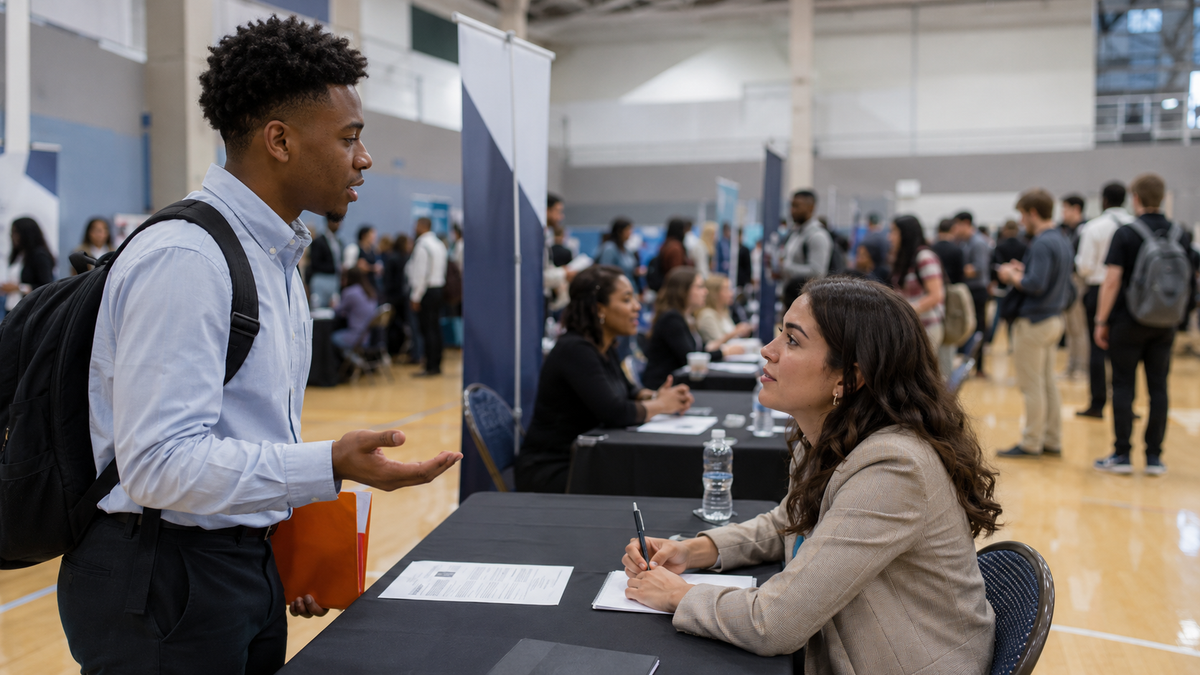
Picture the scene: a hundred folding tables, company banners, and a line of students snaking around the gym. The student at the front finally gets to the recruiter, shakes hands, and says, “Hi, I’m interested in, like, whatever positions you have available.”
The recruiter smiles, takes the resume, puts it in the bottom stack, and moves on. That student stood in line for twenty minutes to be forgotten in four seconds.
That student could be you, if you treat the next three weeks as background noise while you settle back into your routine. Or, this can be the moment you decide to actually prepare.
The difference between a callback and a polite “we’ll be in touch” is not your GPA. It’s not your outfit. It’s whether you did the work before you walked through the door.
Step One: Build Your Target List Before Everyone Else Does
Your career center will publish the list of attending companies. The day it drops, most students scroll through it once and close the tab. Do not be that student.
Print the list. Go through it company by company. For each one, ask yourself three questions:
- Do I actually know what this company does?
- Do they hire for roles that match where I want to go?
- Is there something specific happening at this company right now — a new product, an expansion, a challenge in their industry — that I could reference in conversation?
From the full list, identify your top five targets. These are the companies you’re going to research deeply, not skim. Then identify a second tier of ten to fifteen that you’d genuinely be open to.
This matters because recruiters can tell the difference between a student who knows their company and a student who read the “About Us” page in the elevator. The former gets a follow-up. The latter gets a branded pen.
Step Two: Do Research That Is Actually Useful
Research does not mean memorizing a company’s mission statement. Recruiters wrote that mission statement. They don’t need you to read it back to them.
Useful research means understanding:
- What the company actually does to make money. Not the tagline — the business model. Who are their customers? What problem do they solve?
- What’s changing in their world right now. Check their newsroom, their LinkedIn company page, and any recent press. Did they just acquire someone? Launch in a new market? Face a regulatory challenge?
- What roles they’re actively hiring for. Look at their careers page before the fair. If they have three open roles in supply chain and you’re a supply chain major, say that out loud when you meet them.
One student I know got an internship offer from a mid-size logistics firm because she walked up and said: “I saw you’re expanding your last-mile delivery operations in the Southeast — I’d love to hear how that’s shaping the roles you’re hiring for.” That question took her fifteen minutes to prepare. It changed the entire conversation.
Step Three: Build a Pitch That Sounds Like a Human Being
The “elevator pitch” concept has been so over-coached that most students now deliver a thirty-second monologue that sounds like a LinkedIn summary read aloud. Recruiters hear forty of those an hour. They stop listening.
Here’s a better frame: you’re not delivering a pitch, you’re starting a conversation. Your opener should be short enough to invite a response.
Try this structure:
- Who you are and what you study — one sentence. This is where your brand statement goes (more on that below).
- Something specific you’ve done — one concrete example. Not “I’m a hard worker.” An actual thing. A project, a result, a role.
- Why this company, specifically — one sentence that proves you did homework.
- An open question — invite them to talk.
The hardest line to write is the one about you. That is what a brand statement is for: one concise sentence about the unique value you bring, said the same way every time so people remember it. “I’m a junior in supply chain who likes fixing the process nobody else wants to touch” is a brand statement. “I’m a hard-working team player” is not.
If you are in The Sparks Mentorship Program, the Brand Coach on the Sparks Mentorship platform is built for exactly this. It is an AI strategist that walks you through what you want to be known for, and why, and turns it into a statement you can say out loud at a recruiter’s table without reading it off a card. Do that before the fair, and the first sentence of every conversation is already written.
The whole thing should take under forty-five seconds. Then stop talking and listen. You will learn more in the next two minutes than any company brochure will tell you, and the recruiter will remember you because you actually seemed interested in them.
Step Four: Fix Your Resume This Week, Not the Night Before
Your resume goes with you to the fair. Which means you have three weeks to make it worth handing over.
One rule that covers most problems: every bullet point should describe a result, not a responsibility. “Responsible for managing social media accounts” tells the recruiter nothing. “Grew Instagram following by 40% in one semester by rebuilding the content calendar” tells them something real.
Go through every line. If a bullet describes what you were supposed to do, rewrite it to describe what actually happened. If you don’t have a number, estimate honestly. “Managed a team of four” is better than “led a team.” “Reduced event setup time by roughly half” is better than “improved efficiency.”
Then take it to your career center and have a human being read it. Not just spell-check it — read it. Ask them: “If you were a recruiter seeing this for the first time, what would you think this person is good at?” The gap between their answer and your intended answer is exactly what you need to fix.
Step Five: The Follow-Up Is the Fair
The career fair does not end when you leave the gym. For most recruiters, the real signal comes after.
Within twenty-four hours of speaking with each recruiter, send a follow-up message. Not a template — a message that references something specific from your conversation. “You mentioned the team is expanding into healthcare clients — I’d love to share a project I worked on in that space” is a message a recruiter will remember. “Thank you for your time, I look forward to hearing from you” is one they will delete.
Connect on LinkedIn the same day. In the connection request, reference the conversation. Keep it to two sentences.
Most of your competition will not do this. That is the only reason it works as well as it does.
Three Weeks Is Enough. Start Today.
You don’t need a perfect resume. You don’t need to know exactly what you want to do with your life. You need five companies researched, a conversation-starter that doesn’t sound canned, and a follow-up message ready to go.
The students who get callbacks are not smarter than you. They just treated the fair like the high-stakes opportunity it actually is — three weeks before everyone else woke up.
Open the company list. Pick your top five. Start tonight.
Sources
- National Association of Colleges and Employers (NACE), “Job Outlook” annual survey reports
- National Association of Colleges and Employers (NACE), “2025 Student Survey Report” — career fair attendance and job-search behavior of the Class of 2025
- Robert Half, “Thank-You Notes Can Tip Scale in Job Candidates’ Favor, Yet Few Write Them” (2017 survey of HR managers)